
Application and OE reference
Vehicle, engine or equipment application, OE number, position, and mounting data are checked before the project enters quotation review.
Exhaust Manifold Casting · OEM Review · Sample Development
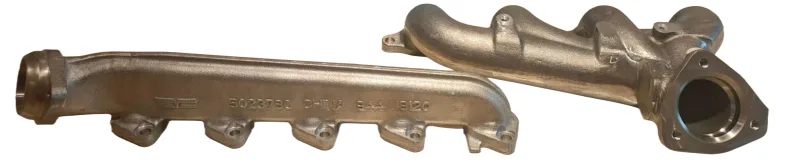
KTECH reviews exhaust manifold casting projects for automotive, heavy-duty diesel, marine diesel, natural-gas and power-generation engines. Project review covers SiMo, D5S, CGI and other suitable heat-resistant material directions, thin-wall and multi-runner geometry, internal passages, machined sealing faces, thermal cycling, leakage risk, and quality documentation before quotation.
Project Review Focus
Vehicle, engine or equipment application, OE number, position, and mounting data are checked before the project enters quotation review.
Thin walls, multi-runner geometry, inner passages, flanges, sealing faces, bolt holes, and machining allowance are reviewed against filling, feeding, distortion and leakage risk.
SiMo ductile iron, D5S high-nickel ductile iron, CGI, heat-resistant cast steel and other suitable directions are reviewed by service temperature, thermal cycling, corrosion, machining and inspection requirements.
Suitable Project Types
For automotive, heavy-duty diesel, marine diesel, natural-gas and power-generation engine programs with application or OE reference data.
For projects where a physical sample, failed part, or current product can be used as the review basis.
For OEM or engineering projects with 2D drawings, 3D files, material requirements, and controlled dimensions.
RFQ Information
Complete information helps confirm the casting route, material direction, tooling and machining scope, inspection requirements, and quotation boundary.
Submit Project DetailsQuality and Delivery Review
Review focuses on filling, feeding, core design, shrinkage risk, leakage risk, distortion and machining stability. Counter-gravity or low-pressure sand casting can be evaluated where the geometry and quality targets justify it.
Material reports, hardness, metallographic review, and heat-resistant material direction can be confirmed by project.
CMM, inspection records, traceability, packaging, and PPAP-related files can be discussed according to buyer needs.
Related Engineering Resources